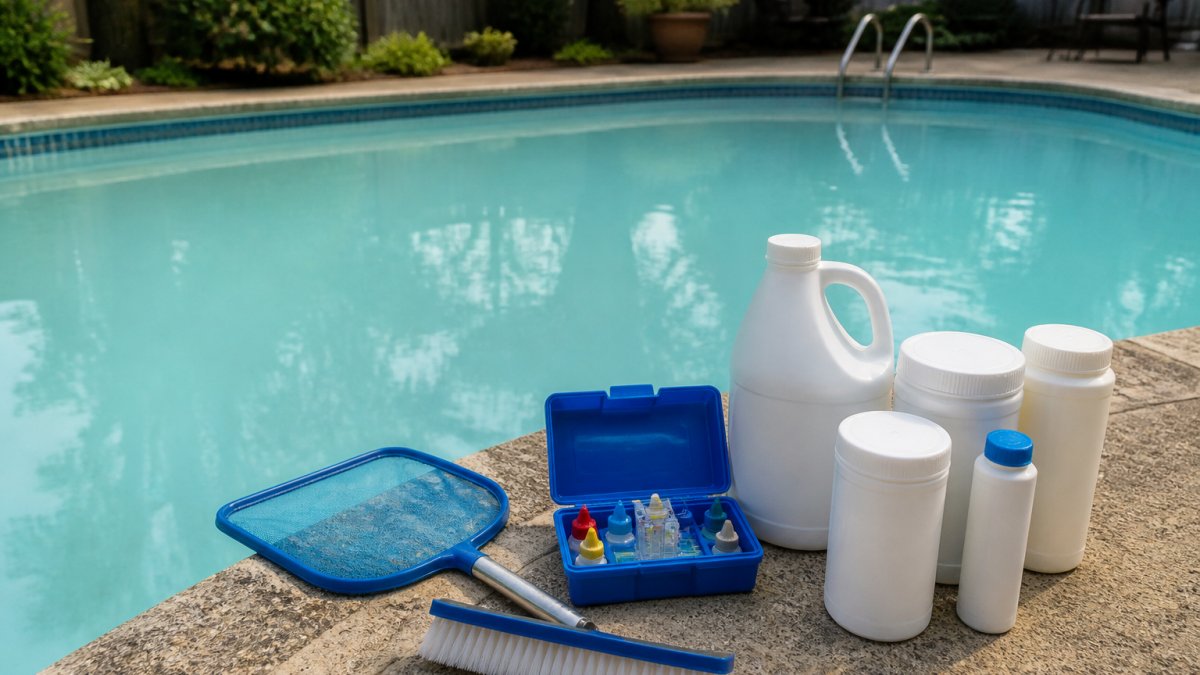
 how-to
How to Clear Cloudy Pool Water Fast: 7-Step Fix
Table of Contents
- Why Cloudy Pool Water Happens and What to Check First
- Step 1: Remove Leaves and Debris From the Pool
- Step 2: Balance pH, Chlorine, and Alkalinity
- Step 3: How to Shock a Pool to Clear Cloudy Water
- Step 4: Clean or Backwash the Pool Filter
- Step 5: How Long to Run a Pool Filter for Clear Water
- Step 6: Pool Clarifier vs. Flocculant: Which One to Use
- Step 7: Troubleshooting When Water Stays Cloudy and When It's Safe to Swim
- Frequently Asked Questions
Last Updated: October 15, 2026
Why Cloudy Pool Water Happens and What to Check First
Cloudy pool water is the most common problem we see on service calls, and it almost always traces back to chemistry, filtration, or debris.
Learning how to clear cloudy pool water fast means treating the cause, not masking the symptom.
Below is the exact 7-step process we use on residential pools, plus the test numbers that tell you where to start.
The Five Most Common Causes of Cloudy Pool Water
Cloudy pool water causes fall into five buckets, and each one needs a different fix:
- Chemical imbalance - high pH or low free chlorine stops sanitizer from working
- Filtration failure - a clogged or dirty filter can't trap fine debris
- Poor water circulation - dead spots let particles settle instead of cycling through
The CDC guidance on healthy swimming and pool water treatment notes that chlorine effectiveness drops sharply as pH climbs above 7.8, which is why testing comes before shocking.
Test Before You Treat: The Numbers That Matter
Water testing is the step most homeowners skip.
According to the CDC's pool chemical safety guidance, free chlorine should stay between 1 and 3 parts per million and pH between 7.2 and 7.8 for a properly sanitized pool. Anything outside that range means your chemicals aren't doing their job.
Test these four values before you add anything:
| Test | Target Range | What It Tells You |
|---|---|---|
| Free chlorine | 1-3 ppm | Whether sanitizer is active |
| pH | 7.2-7.8 | Whether chlorine can work |
| Total alkalinity | 80-120 ppm | Whether pH will hold steady |
| Cyanuric acid | 30-50 ppm | Whether chlorine is protected from sun |
If your test kit only reads chlorine and pH, get a full kit. You can't fix what you can't measure.
Step 1: Remove Leaves and Debris From the Pool
Skim, brush, and vacuum before you touch a single chemical. Organic debris eats chlorine, so leaves on the bottom will fight every chemical you add.
Here's the order that works:
- Skim the surface with a leaf net
- Brush walls, steps, and the waterline
- Vacuum the floor, or run a robotic cleaner
- Empty skimmer baskets and pump baskets
This takes 20 to 30 minutes on a typical backyard pool, the least glamorous step, and the one that saves the most money on chemicals.
Step 2: Balance pH, Chlorine, and Alkalinity
Balancing water chemistry means getting pH, alkalinity, and chlorine into range before you shock. Chlorine works poorly at high pH, so a pool at pH 8.2 can test with "enough" chlorine and still be cloudy.
- pH too high (above 7.8): add muriatic acid or a pH decreaser
- pH too low (below 7.2): add soda ash
- Alkalinity low: add sodium bicarbonate
Add one chemical at a time, run the pump at least an hour, then retest. Chasing two adjustments at once usually overshoots both.
Step 3: How to Shock a Pool to Clear Cloudy Water
Shocking raises free chlorine high enough to burn off contaminants, the fastest way to kill algae and break down organic waste. Use a shock labeled for your pool type, and dose by pool volume, not guesswork.
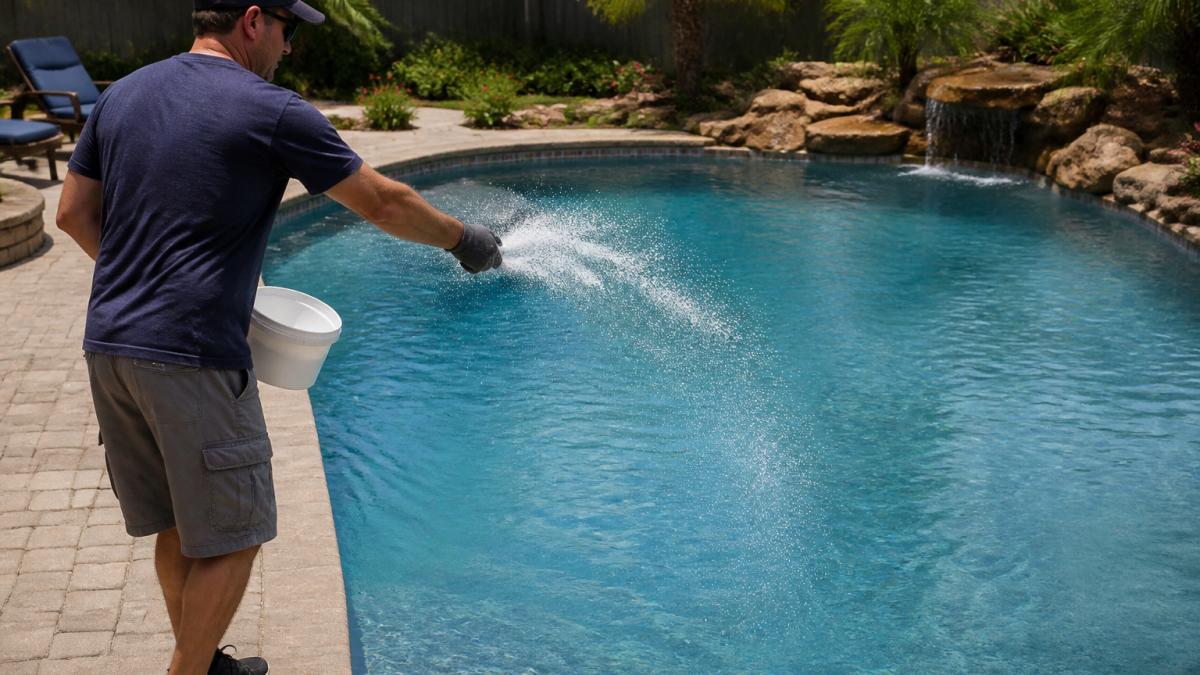
Dosing is measured in ounces per 10,000 gallons, and your shock label gives the exact amount, for a 20,000-gallon pool, usually double the base dose.
Step 4: Clean or Backwash the Pool Filter
A dirty filter is the hidden cause behind most stubborn cloudy pools. If it can't trap fine debris, no amount of shock or clarifier will clear the water, and "clean the filter" means something different for sand, cartridge, and DE systems.
Start with the pressure gauge. Every filter has a clean baseline pressure recorded after the last cleaning or backwash, write that number on the tank so you stop guessing.
Sand Filters
- Backwash when the gauge reads 8-10 psi above baseline, not on a calendar schedule.
- Turn the multiport valve to Backwash, run until the sight glass clears (2-3 minutes), then Rinse 30-60 seconds before returning to Filter.
- Never backwash while the pump runs through the Filter position, you'll send debris back into the pool.
Cartridge Filters
- Shut off the pump, relieve pressure, and pull the cartridge. Hose it top-to-bottom between the pleats, a wide spray from the inside out pushes debris out instead of driving it deeper.
- Deep-clean monthly with a cartridge cleaner soak to strip oils and sunscreen hosing won't remove.
- Replace the cartridge when pleats stay matted, end caps crack, or cleaning no longer restores baseline pressure. Most last 1-3 seasons depending on bather load.
DE (Diatomaceous Earth) Filters
- Backwash when pressure rises 8-10 psi above baseline, same as sand, then rinse.
- After every backwash, recharge the filter with fresh DE through the skimmer, roughly 1 pound per 10 square feet of filter area, per the label. Skipping this lets DE grids run bare and pass debris straight through.
- DE gives the finest filtration of the three, best for fine haze and dead algae, but it clogs fastest, so expect more frequent cleaning during a cloudiness event.
When Cleaning Won't Fix It
If the pressure gauge hasn't moved in weeks, that's a red flag: either the gauge is broken or the pump isn't moving water. Tap the gauge and watch for movement, then verify flow at the returns.
A filter that's been cleaned, recharged, and still won't hold pressure usually means a torn or channeled media, a cracked manifold or grid, or a pump impeller clogged with debris, any of which keeps water cloudy no matter how much shock or clarifier you add.
Once the filter is genuinely clean and holding pressure, move on to circulation, a clean filter can't compensate for a pump that isn't running long enough.
Step 5: How Long to Run a Pool Filter for Clear Water
Run the filtration system 24 hours a day until the water clears, then drop back to your normal schedule.
For a typical residential pool, "normal" means 8 to 12 hours per day, split between morning and evening.
Watch the returns. If water isn't visibly moving at every jet, you have a circulation problem, not a chemistry problem. Check the impeller, skimmer, and pump basket for blockages.
Step 6: Pool Clarifier vs. Flocculant: Which One to Use
Pool clarifier and pool flocculant both clear cloudy water, but they work differently. Pick the wrong one and you'll waste a week, or clog a filter you just cleaned.
The short version: clarifier is a filter aid, flocculant is a settling agent. Clarifier binds fine particles into small clumps the filter catches while the pump runs. Flocculant clumps particles into heavy masses that sink for vacuuming to waste, so the pump must be off 12 to 24 hours while they settle.
The Decision Guide
| Situation | Best Choice | Why |
|---|---|---|
| Slightly hazy water, filter working | Clarifier | Filter traps the clumped particles; no downtime |
| Milkshake-thick water, filter struggling | Flocculant | Drops particles for vacuuming to waste |
| Dead algae on the floor | Flocculant | Sinks debris for removal instead of re-suspending it |
| Routine weekly maintenance | Clarifier | Prevents haze from forming in the first place |
| DE filter in use | Clarifier | Flocculant can coat and ruin DE grids |
| Cartridge filter, heavy load | Flocculant with filter bypassed | Avoids loading the cartridge with clumped debris |
Dosing by Pool Volume
Both products are dosed by pool volume, and your bottle's label is the final word. As a working range most manufacturers publish:
- Clarifier: roughly 1 ounce per 5,000 gallons for maintenance, up to 1 ounce per 2,500 gallons for a heavy haze. A 20,000-gallon pool typically needs 4-8 ounces.
- Flocculant: roughly 1 ounce per 5,000 gallons, or about 4 ounces per 20,000 gallons. Some liquid flocculants call for 8-16 ounces per 10,000 gallons, read the bottle, because concentrations vary widely between brands.
Never combine clarifier and flocculant in the same dose, they work against each other and can leave a worse mess. Never mix either with shock in the same application: add one, let it work, then reassess.
What to Do With Settled Debris
This is the step most guides skip, and where flocculant jobs go wrong.
- After the pump has been off 12-24 hours, look at the floor. You should see a distinct layer of debris.
- Set the multiport valve to Waste (not Filter, not Backwash).
- Vacuum slowly, directly to waste, without brushing first, brushing re-suspends everything you just settled.
- Watch the water level. Vacuuming to waste dumps pool water, so top off afterward.
- Once the floor is clear, return the valve to Filter, restart the pump, and retest chemistry before adding anything else.
If you vacuum on the Filter setting by mistake, the debris goes straight into your filter media and you'll be backwashing for an hour.
Timing and Realistic Expectations
- Clarifier: visible improvement in 24-48 hours with the pump running continuously, the faster, lower-risk option for mild cloudiness.
- Flocculant: 12-24 hours of pump-off settling, 30-60 minutes of vacuuming, then 24 hours of filtration to polish. Total: roughly 2-3 days.
Neither product fixes a chemistry problem. If pH is above 7.8 or free chlorine below 1 ppm, treat that first, both underperform in unbalanced water.
Once the water is clear, retest pH, free chlorine, and cyanuric acid before anyone swims. Clear water isn't the same as sanitized water.
Step 7: Troubleshooting When Water Stays Cloudy and When It's Safe to Swim
Retest everything against the target table above, then check filter pressure and return flow.
Swimming readiness comes down to two numbers. Free chlorine should be back between 1 and 3 ppm, and pH between 7.2 and 7.8.
The EPA's guidance on safe pool water recommends keeping disinfectant levels within range at all times, not just after treatment.
A common mistake is assuming cloudy water is safe because it "looks clean." It can still carry bacteria, and low chlorine gives them room to grow.
Frequently Asked Questions
Can too much chlorine make a pool cloudy?
Yes. Over-stabilized or over-chlorinated water can turn cloudy when high chlorine levels bind with other chemicals or when cyanuric acid locks the chlorine. Test free chlorine and pH before adding more. If free chlorine reads above 5 ppm and the water is still hazy, stop adding shock and let levels drop naturally before retesting.
How long does it take shock to clear a cloudy pool?
Most cloudy pools show improvement within 24 to 48 hours after shocking, provided the filter runs continuously and pH is in range. Severe cloudiness from algae or heavy debris may take several days. Retest free chlorine and pH each morning. If the water is still hazy after 72 hours, check the filter and consider a clarifier or flocculant.
Will a cloudy pool clear on its own?
Rarely. Cloudy pool water usually points to a chemical imbalance, a clogged filter, or suspended particles that will not settle without intervention. Running the pump longer can help with mild cases, but most pools need testing, balancing, and either shock or a clarifier. Ignoring it often leads to algae growth and a bigger cleanup.
Should I run the pool filter continuously to clear cloudy water?
Yes. Run the filtration system 24 hours a day until the water clears, then return to your normal schedule. Most pools need 8 to 12 hours of daily filtration, but clearing cloudy water requires continuous circulation. Backwash or clean the filter when pressure rises 8 to 10 psi above the clean baseline, and retest the water after each cycle.
Cloudy water rarely clears on its own, and guessing at chemicals gets expensive fast. If you're tired of chasing clarity with trial-and-error dosing, Pool Perfection LLC can take it off your plate. We're family owned and operated, licensed and insured, and we handle weekly maintenance, water testing, and equipment repairs for both homes and commercial properties. Book your appointment with Pool Perfection LLC and get back to a pool you can actually see the bottom of.