 blog
Pool Pump Repair vs Replacement Cost: 2026 Guide
Table of Contents
- Pool Pump Repair vs Replacement Cost: The Short Answer
- Signs of a Failing Pool Pump You Should Not Ignore
- What a Pool Pump Repair Cost Actually Covers
- Pool Pump Motor Replacement Cost vs a Full Pump Swap
- Pool Pump Lifespan: When Repair Stops Paying Off
- How to Evaluate a Repair or Replacement Quote
- The 50% Rule and Long-Term Operating Costs
- Conclusion
- Frequently Asked Questions
Last Updated: October 18, 2026
Pool Pump Repair vs Replacement Cost: The Short Answer
The pool pump repair vs replacement cost decision usually comes down to one question: will the fix cost more than half the price of a new pump? If yes, replace it.
At Pool Perfection LLC, we walk homeowners through this math, and the honest answer is rarely the expensive one. A worn shaft seal or motor can often be a straightforward fix.
Signs of a Failing Pool Pump You Should Not Ignore
Most pump failures announce themselves well before the pump dies. Catching the warning signs early is the difference between a small repair bill and a full replacement, so pay attention to how your pump sounds, looks, and moves water.
Symptoms That Point to a Cheap Fix
These issues are usually repairable for a modest cost, and a technician can often handle them in a single service call:
- Unusual noise like grinding or squealing, often a worn bearing or a failing motor
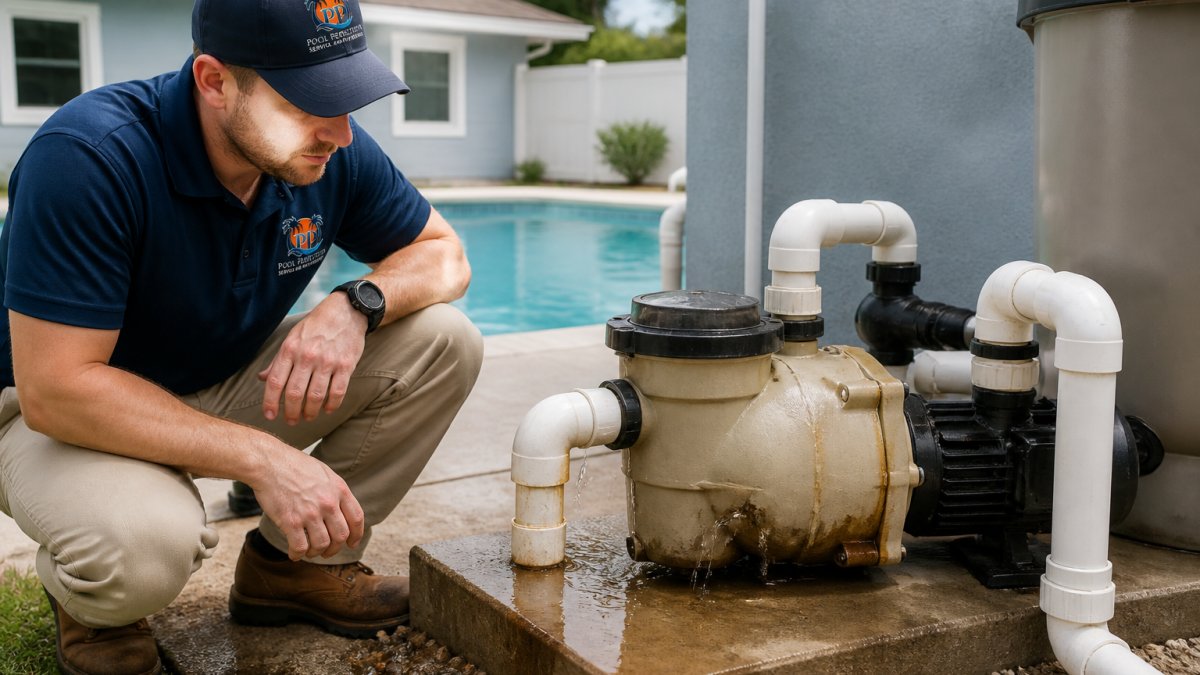
- Leaks around the housing, frequently a worn shaft seal or O-ring
- Low water flow from a clogged basket, a blocked impeller, or a dirty filter
- Overheating from restricted airflow or debris buildup
Symptoms That Usually Mean Replacement
Some failures are not worth patching, especially on an older pump:
- A cracked or warped pump body that cannot be sealed reliably
- Electrical issues inside the motor that keep recurring
- A pump that has already been rebuilt once and is failing again
- A motor that trips the breaker no matter what you replace
What a Pool Pump Repair Cost Actually Covers
A pool pump repair cost is built from two pieces: parts and labor. Understanding both helps you spot a fair quote from an inflated one.
Parts and Labor Breakdown
The parts side depends entirely on what failed. Common repairable components include:
- Shaft seal: a small part that prevents leaks, but ignoring it can ruin the motor
- Impeller: drives water flow and can clog or wear down
- Bearings: cause grinding noise when they fail
- O-rings and gaskets: cheap seals that stop drips
Labor covers the service call, diagnosis, and installation time. A simple part swap takes far less time than a full pump rebuild, and that difference shows up on the invoice. Site conditions matter too: a cramped pump pad or tricky plumbing adds time.
Pool Pump Motor Replacement Cost vs a Full Pump Swap
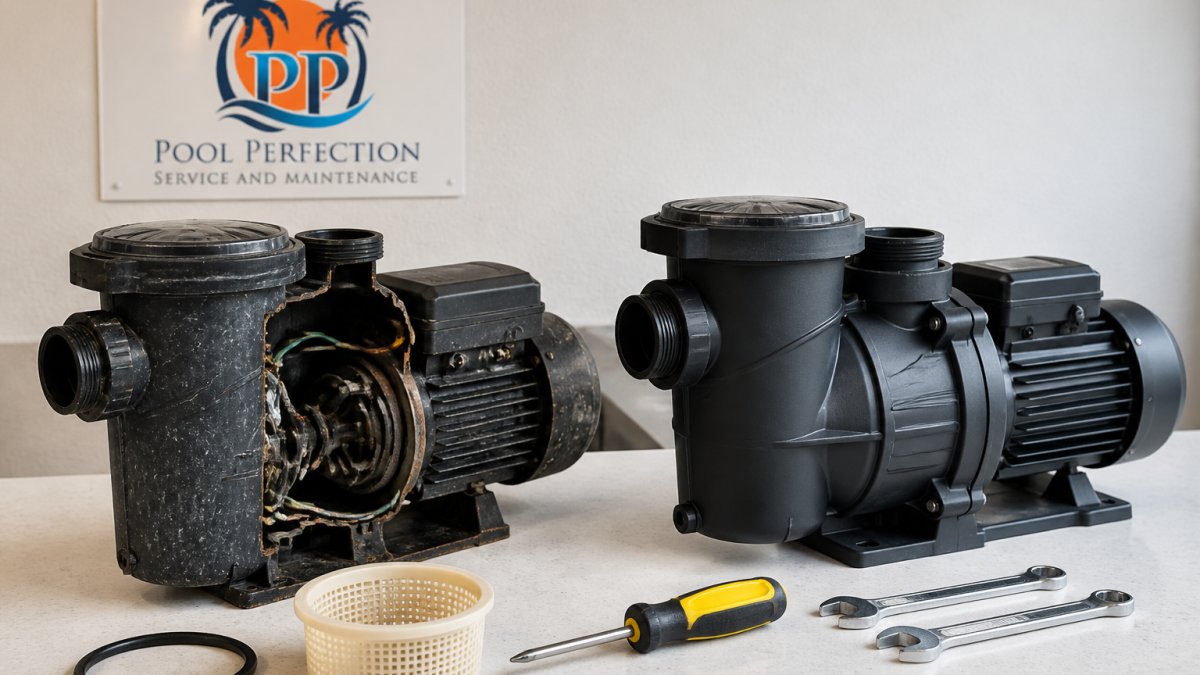
A pool pump motor replacement cost sits between a small component repair and a complete pump swap. When the motor itself is the problem but the pump body, housing, and plumbing are still sound, swapping just the motor can be the smart middle path. The key is understanding what you are actually paying for at each tier.
What Each Option Really Costs
Component repairs are the least expensive because the parts are small and the labor is short. A shaft seal, O-ring, or impeller replacement typically involves a single service call and a part that costs far less than the labor to install it.
A common pattern is that motor-only replacement lands at roughly half to two-thirds of the installed cost of a comparable full pump, depending on motor size and whether the existing wiring and plumbing can be reused.
When Motor-Only Replacement Wins
Motor-only replacement is usually the right call when the housing, seal plate, and impeller are in good shape and the failure is electrical or mechanical inside the motor itself. It also wins when the existing pump is a standard frame size that a replacement motor can match without adapters. If the pump is a newer variable-speed model with a failed motor, replacing just the motor can preserve the drive and controls you already paid for.
When a Full Pump Swap Wins
A complete pump replacement is the better call when the housing is compromised, when the pump is near the end of its service life, or when the existing pump is an older single-speed unit and the owner wants to move to a variable-speed pump for energy savings. In those cases, paying for a motor-only swap puts new parts into a body that is likely to fail next.
Option | What Gets Replaced | Best For | Relative Cost |
|---|---|---|---|
Component repair | Capacitor, seal, impeller, bearings | Recent pump, single failed part | Lowest |
Motor-only replacement | Motor only, housing reused | Sound pump body, failed motor | Moderate |
Complete pump replacement | Entire pump unit | Old pump, cracked body, repeated failures | Highest |
For a closer look at how pump choice affects long-term energy use, ENERGY STAR's guidance on pool pump efficiency explains how variable-speed pumps compare with single-speed models.
Pool Pump Lifespan: When Repair Stops Paying Off
A typical pool pump lasts somewhere in the range of 8 to 12 years with regular care, though run time, water chemistry, and climate all shift that number. Once a pump crosses that threshold, repairs start to look like rent payments on a dying machine.
Warranty, Age, and Remaining Service Life
Warranty coverage changes the math fast. A pump still under warranty may be repaired or replaced at little cost to you, so check the paperwork before approving any work. Past the warranty window, weigh the pump's age against the repair bill.
Ask yourself three questions:
- How old is the pump compared to its expected service life?
- Has it already been repaired or rebuilt recently?
- Will this fix buy years of service, or months?
If the pump is near the end of its expected life and the repair is substantial, replacement usually wins.
How to Evaluate a Repair or Replacement Quote
A repair quote and a replacement quote should both be itemized. Ask for a written breakdown of parts, labor, and the service call fee before you commit. Vague lump-sum numbers are a red flag.
Use this checklist when a quote lands in your inbox:
- Parts listed by name, not "miscellaneous"
- Labor hours or a flat rate stated clearly
- Service call fee disclosed up front
- Diagnosis explaining why the repair is needed
- Warranty terms on parts and labor
- For replacement: pump model, efficiency rating, and installation included
- Any code or electrical upgrades called out separately
A trustworthy provider explains the reasoning, not just the price. At Pool Perfection LLC, we itemize every quote so homeowners can see exactly what they are paying for and why.
The 50% Rule and Long-Term Operating Costs
The 50% rule is a simple repair threshold: if the repair cost approaches half the price of a new pump, replacement is usually the better financial move. It is not a hard law, but it is a reliable starting point. The rule works because a repair that consumes half the value of a new pump leaves you with an old pump that is likely to need another repair soon, while a new pump resets the clock on service life and warranty.
Why the 50% Rule Works
The logic is about remaining value, not just the current bill. If a pump has five years of service life left and the repair costs half the price of a new pump, you are paying new-pump money for old-pump reliability. The rule is a shortcut for that comparison. It is most reliable when the pump is past its warranty and has already had one repair in the past two years.
The Operating Cost Angle Most Quotes Miss
Operating costs matter just as much as the upfront bill, and this is where a repair-versus-replacement decision can flip. An older single-speed pump runs at one speed all day, cycling on and off to filter the pool.
The payback math works like this: the variable-speed pump costs more upfront, but the annual electricity savings reduce the effective cost difference over several seasons. The exact payback depends on your electric rate, run time, pump size, and how much of the day the pump runs at low speed.
How to Compare a Repair to a Replacement on Total Cost
Use a simple side-by-side comparison rather than a single number:
- Repair quote: parts, labor, service call, and any warranty on the repair
- Replacement quote: pump model, efficiency rating, installation, and any plumbing or electrical changes
- Expected remaining life: how many years the repaired pump is likely to last versus a new pump
- Annual electricity cost: estimate the current pump's usage and the replacement's usage at your electric rate
- Warranty coverage: what is covered and for how long on each path
When the repair quote is high, the pump is old, and the replacement is a variable-speed model, the total-cost comparison often favors replacement even when the sticker price looks higher. When the repair is small and the pump is young, repair wins on both upfront and total cost.
The U.S. Department of Energy's pool pump standards cover efficiency requirements that shape which pumps are available today, and those standards are one reason variable-speed pumps have become the default replacement choice.
Conclusion
Deciding between repair and replacement is stressful when you are staring at a broken pump and a quote you do not fully understand.
Pool Perfection LLC is a family-owned, licensed and insured team that handles residential and commercial pool repairs with honest pricing and clear, itemized quotes. We diagnose the actual problem, explain your options, and never push an upgrade you do not need.
Book your appointment with Pool Perfection LLC and get a straight answer on whether to repair or replace your pump.
Frequently Asked Questions
Is it worth repairing a pool pump?
It depends on the pump's age and the size of the repair. A capacitor, shaft seal, or clogged impeller fix is usually worth it on a pump under eight years old, because the repair is a small fraction of a new pump. Once the pump is near the end of its pool pump lifespan or the repair approaches half the price of a new unit, replacement usually wins. Ask for a written quote that separates parts and labor so you can compare both paths fairly.
Should I replace my entire pool pump or just the motor?
A motor-only replacement makes sense when the pump body, housing, and plumbing connections are in good shape and the motor is the only failed part. If the pump body is cracked, the housing is warped, or the pump is old enough that a new motor will outlive the rest of the unit, a complete pump is the better call. Compare the pool pump motor replacement cost against a full replacement quote and factor in warranty coverage on both.
What are the signs that a pool pump needs to be replaced?
Watch for unusual noise like grinding or rattling, leaks around the seal, overheating, low pressure at the returns, a pump that shuts off on its own, or a basket that clogs constantly despite cleaning. These signs of a failing pool pump can also point to a repairable issue, so get a diagnosis before assuming the worst. Repeated failures within a season are the clearest signal that replacement is the smarter spend.
Can a variable-speed pool pump lower operating costs?
Yes. Variable-speed pumps run at lower speeds for longer periods, and because electricity costs scale steeply with motor speed, that usually cuts energy use compared with a single-speed pump running full tilt. The savings show up most in pools that run many hours per day. Ask for a quote that shows the estimated electricity costs for your run schedule so you can weigh the upfront price against long-term savings.