 how-to
Why Does Pool Algae Keep Coming Back?
Last Updated: November 1, 2026
Quick Summary
Persistent pool algae usually survives because chlorine is consumed before it can work, circulation leaves dead spots, or the filter is overwhelmed. Shocking kills what is floating but does not fix these conditions, so growth returns. Identify the algae type and correct water chemistry, filtration, and brushing order.
- Black algae forms sticky spots with roots and needs aggressive brushing and a longer treatment window than green algae.
- High pH weakens chlorine's ability to kill algae, so balance pH before alkalinity and stabilizer.
- When stabilizer is high, you need proportionally more free chlorine for the same killing power.
- Brush first, then vacuum to waste, then shock and run the pump continuously for at least 24 hours.
- If free chlorine drops sharply overnight, organic matter is still consuming it, so keep brushing and hold chlorine.
Table of Contents
- Why Pool Algae Keeps Coming Back After Treatment
- Step 1: Identify the Algae Type Before You Treat
- Step 2: Fix Pool Water Chemistry for Algae Prevention
- Step 3: Rule Out Pool Filter Problems Causing Algae
- Step 4: Brush, Vacuum, and Shock in the Right Order
- How Long to Clear a Green Pool (and How to Retest)
- When Persistent Algae Needs a Professional Evaluation
- Schedule a Water Test and Algae Recovery Plan
- Frequently Asked Questions
Why Pool Algae Keeps Coming Back After Treatment
If you're troubleshooting persistent pool algae growth, the hard truth is that algae rarely survives because you didn't shock hard enough. It survives because something in your water, filter, or routine keeps resetting the clock. Pool owners often describe this same cycle: a pool turns green, the owner shocks it, the water clears for a week, then the green returns.
Algae spores are always present in outdoor pool water. You can't eliminate them, only outpace them. When growth returns fast, one of three things is happening.
The Three Reasons Algae Survives a Shock
- Chlorine is being consumed before it can work. Sunlight, debris, and low stabilizer levels burn through free chlorine fast.
- Circulation is poor. Dead spots let algae settle on walls and the floor where sanitizer never reaches.
- The filter is overwhelmed. A clogged or channeled filter can't capture the particles algae feed on.
Shocking kills what's floating. It doesn't fix the conditions that let algae bloom again. That's the part that matters most.
Step 1: Identify the Algae Type Before You Treat
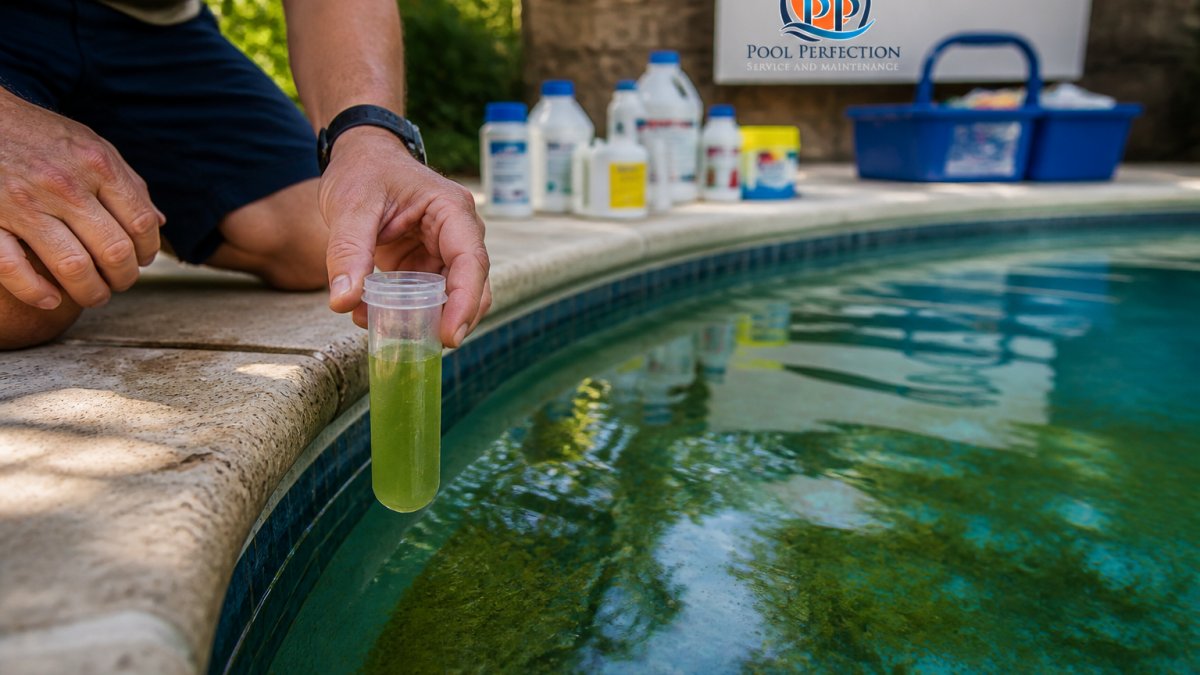
Green algae is the most common and the easiest to clear. It turns water cloudy or bright green and wipes off surfaces easily.
Why does the type matter? Because black algae needs aggressive brushing and a longer treatment window than green algae. Treating black algae like green algae is one of the most common reasons pool algae keeps coming back.
Before you buy anything, look closely at where the growth sits and how it responds to a brush. That tells you what you're fighting.
Step 2: Fix Pool Water Chemistry for Algae Prevention
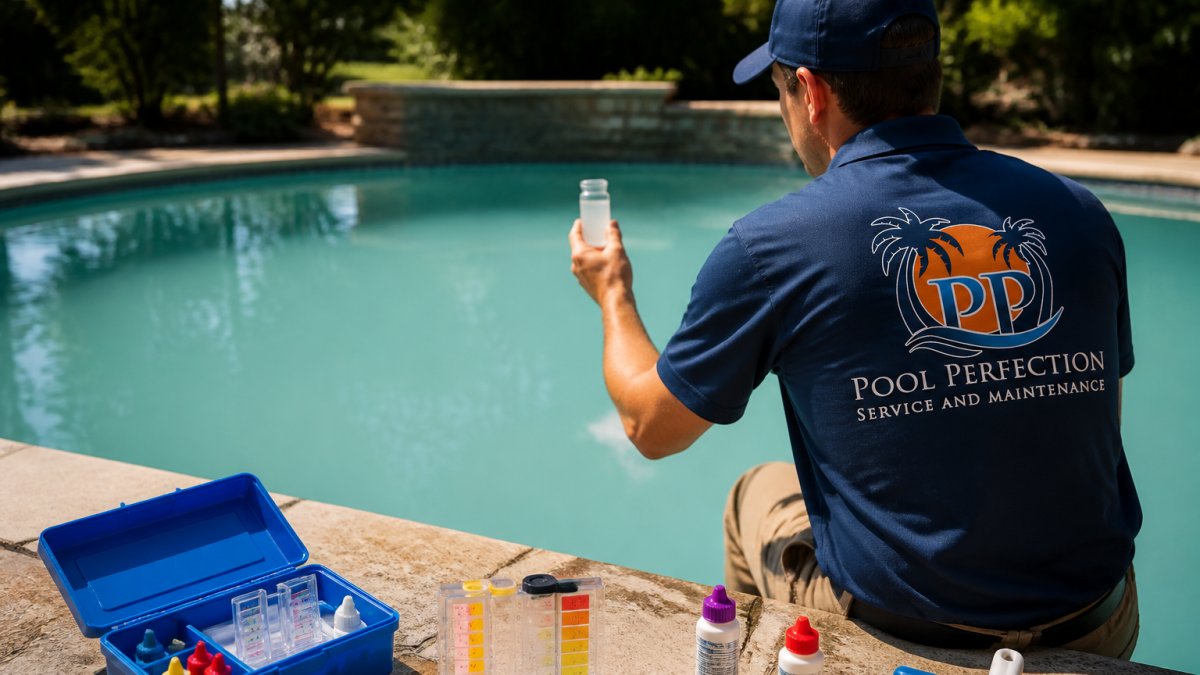
Good pool water chemistry for algae prevention starts with accurate testing, not with adding more chemicals. Test strips are fast, but they can drift and mislead you on chlorine and stabilizer readings. Our guide on the differences between pool test strips and liquid kits explains which readings you can trust.
A common testing mistake is collecting a sample from the surface near the return jet, where water is freshest. Dip elbow-deep, away from returns and skimmers, and read the test in good light.
Once you have real numbers, balance in this order:
- pH first. High pH weakens chlorine's ability to kill algae (the CDC). Aim for the range your test kit recommends, usually in the mid-7s.
- Alkalinity next. It keeps pH from swinging, so fix it before chasing pH again.
- Stabilizer (cyanuric acid). It protects chlorine from sunlight, but too much locks chlorine up.
- Free chlorine last. Bring it to the level your test kit calls for and hold it there.
Free Chlorine vs. Cyanuric Acid: The Ratio That Matters
Here's a troubleshooting detail that often gets overlooked. Free chlorine and cyanuric acid work as a pair. Cyanuric acid shields chlorine from sunlight, which is helpful, until it climbs too high.
A practical way to read the pair: compare your free chlorine number against your stabilizer number rather than against a fixed target. When stabilizer is high, you need proportionally more free chlorine to get the same killing power.
Reading the Numbers Like a Troubleshooter
Instead of asking "is my chlorine high enough," ask what the test results tell you about why algae is surviving:
- Free chlorine drops to near zero within a day of shocking: something organic is still consuming it, algae, debris, or a dirty filter. Keep brushing and clean the filter before adding more.
- Free chlorine holds but algae returns: likely a stabilizer imbalance or poor circulation leaving dead spots untreated.
- pH keeps drifting up: check alkalinity and aeration; unstable pH makes chlorine less predictable.
- Stabilizer climbs every week: your chlorine product is adding it faster than splash-out and rain remove it. Plan a partial drain and refill, and confirm the target with your test kit.
Treating a number is different from troubleshooting a pool. When the readings don't add up, it can help to get a second set of eyes on the water and equipment.
Step 3: Rule Out Pool Filter Problems Causing Algae
Pool filter problems causing algae are easy to overlook because the pump still runs. Check these before you spend more on chemicals:
- Pressure gauge: A reading well above your clean starting point means the filter is loaded and needs cleaning or backwashing.
- Return flow: Weak returns mean poor circulation, and poor circulation means dead spots.
- Filter media: Torn cartridges, channeled sand, or worn grids let debris pass straight through.
- Run time: Short cycles leave water under-filtered. Algae thrives on still water.
If the pump itself is noisy, losing prime, or cycling off, filtration is suspect. Before you sink money into repairs, it helps to weigh pool pump repair versus replacement so you're not guessing.
Watch out: backwashing too often on a sand filter can actually worsen filtration, so follow your filter's guidance rather than a habit.
Step 4: Brush, Vacuum, and Shock in the Right Order
Order matters more than most people think. Brush first.
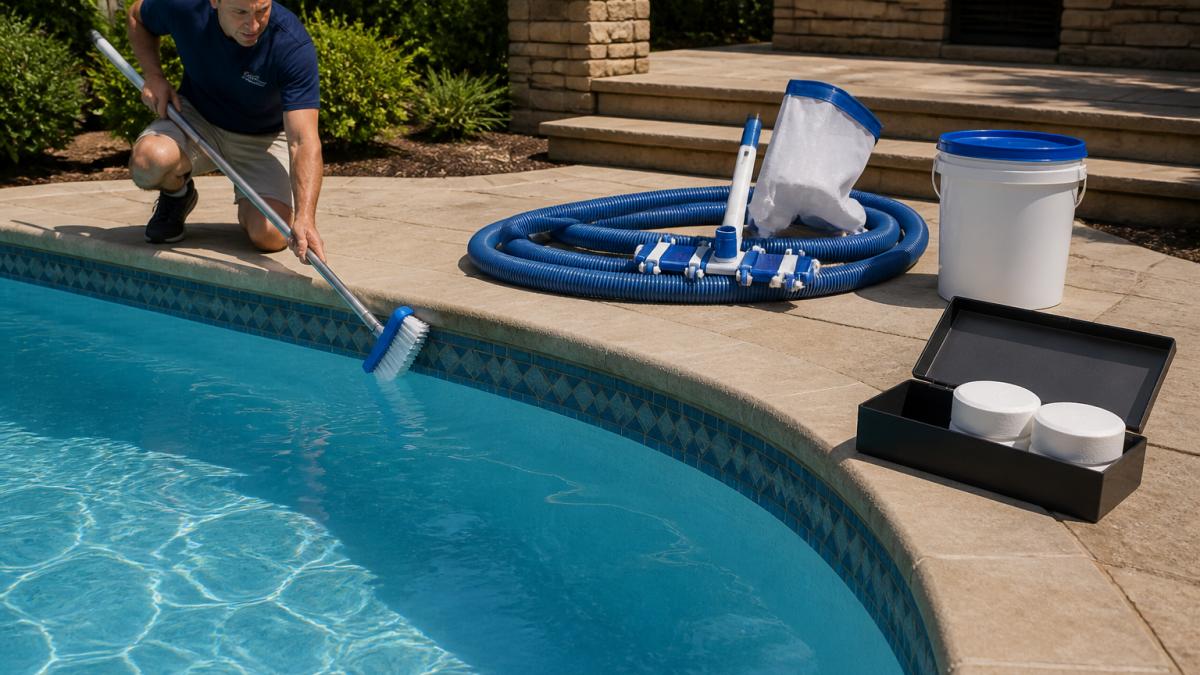
Then vacuum to waste if you can, so the loosened debris leaves the pool instead of loading the filter. Skim leaves and debris out first, since organic matter eats your chlorine.
Now shock the pool. Use a shock product labeled for your pool type, follow the label dose, and run the pump continuously for at least 24 hours.
How Long to Clear a Green Pool (and How to Retest)
Many green pools clear within a few days with consistent brushing, filtration, and held chlorine levels. Black algae can take a week or more. But "how long" is the wrong question on its own. The better question is how you'll know the treatment actually worked, and what to do if it didn't.
A Measurable Recovery Schedule
Work through this sequence instead of guessing, and record your readings each time so you can compare:
| Timeframe | What to Do | What Tells You It's Working |
|---|---|---|
| Before you start | Test full chemistry, note free chlorine, pH, alkalinity, and stabilizer; brush all surfaces; clean or backwash the filter | You have a baseline to measure against |
| Every 24 hours | Test free chlorine and pH, brush walls and floor, skim debris | Free chlorine holds closer to target between doses |
| Day 2-3 | Check filter pressure, clean or backwash as needed, confirm return flow is strong | Pressure stays near the clean starting point; water clears |
| When water clears | Retest full chemistry, rebalance pH and alkalinity, vacuum any settled debris | No visible growth on walls, steps, or waterline tile |
| One week later | Retest stabilizer and chlorine; brush corners and shady walls to check for regrowth | Chlorine holds overnight; no new patches appear |
The Overnight Chlorine Test
The clearest sign that you've beaten the bloom is whether free chlorine holds overnight. Test free chlorine after sunset and again before sunrise. If it drops sharply overnight, something organic is still in the water consuming it, keep brushing, keep the filter clean, and hold your chlorine level. If it holds overnight and the water is clear, you've turned the corner. This single check separates "the water looks better" from "the problem is actually resolved."
If Algae Keeps Coming Back: A Diagnostic Path
When growth returns after a treatment that seemed to work, stop repeating the same steps and work through likely causes in order:
- Sanitizer: Is free chlorine holding overnight, and is it proportional to your stabilizer level? If not, revisit Step 2.
- Circulation: Are returns strong, and are there dead spots behind ladders, in corners, or on steps where water barely moves? Algae settles where sanitizer doesn't reach.
- Filtration: Is the pressure gauge near its clean starting point, and is the media intact? A channeled sand bed or torn cartridge passes debris straight through.
- Testing accuracy: Are you sampling elbow-deep, away from returns, with a reliable kit? Imprecise readings hide the real problem.
- Environmental pressure: Heavy use, rain, debris, and hot sunny stretches raise algae pressure. A pool that was fine last month may need a higher chlorine hold or more run time now.
If you work through all five and the green still returns, the cause is usually something a test kit can't show, a circulation dead zone, a failing filter component, or a chemical feed problem that needs eyes on the equipment. That's the point to bring in help rather than buy another jug of shock.
When Persistent Algae Needs a Professional Evaluation
Sometimes the water tests fine, the filter runs, and the pool still turns green. At that point, the cause is usually something a test kit can't show: a circulation dead zone, a failing filter component, or a chemical feed problem that needs eyes on the equipment.
That's when it makes sense to bring in help. If you're ready to hand it off, our guide on finding local pool maintenance service walks through what to ask and what to check before you hire.
Schedule a Water Test and Algae Recovery Plan
Recurring algae is a signal, not a sentence. It usually means your water, filter, or routine needs a reset, and once you find the weak link, the green stays gone.
As a family-owned and operated company, we treat every pool like our own. Pool Perfection LLC offers reliable weekly maintenance and water testing, so you don't have to keep chasing the same problem.
Get started with Pool Perfection LLC and book your appointment for a water test and a clear-pool plan.
Frequently Asked Questions
How to get rid of algae that keeps coming back?
Algae that returns after every treatment usually means the cause was never fixed. Test the water and correct pH, alkalinity, and stabilizer levels first, then check that free chlorine is high enough relative to cyanuric acid. Brush every surface, run the pump continuously, clean or backwash the filter, and shock the pool. Retest within 24 hours and repeat the shock if chlorine drops. If growth returns within a week or two, the filter or circulation is the likely culprit and needs a closer look.
Does chlorine kill pool algae?
Chlorine kills algae, but only when enough of it is free and active in the water. If cyanuric acid is too high, chlorine gets locked up and algae survives even after you add more. If pH is off or the filter is clogged, chlorine gets used up before it can work. Shocking raises free chlorine fast, but it only holds if water chemistry and circulation are already in balance. Test free chlorine and cyanuric acid together before assuming you need more chlorine.
Can poor filtration or circulation cause pool algae to return?
Yes. A filter that is clogged, backwashed too little, or undersized for the pool lets algae spores and debris keep recirculating. Weak return jets, dead spots, and short pump run times leave parts of the pool with little movement, which is where algae takes hold first. Check filter pressure, confirm the pump runs long enough each day, and watch the returns for strong flow. Fixing circulation often solves recurring algae that chemicals alone cannot.
How long does it take to clear a pool after treating algae?
Green pools often begin to clear within a day or two after a proper shock and brush, with full clarity depending on how green the pool was and how well the filter works. Black or mustard algae can take longer. Retest free chlorine daily during recovery, keep the pump running continuously, and clean the filter as pressure rises. If the water is not visibly improving after three days, stop adding chemicals and diagnose filtration and circulation instead.